Things to know about this Dwarf mountain pine kit
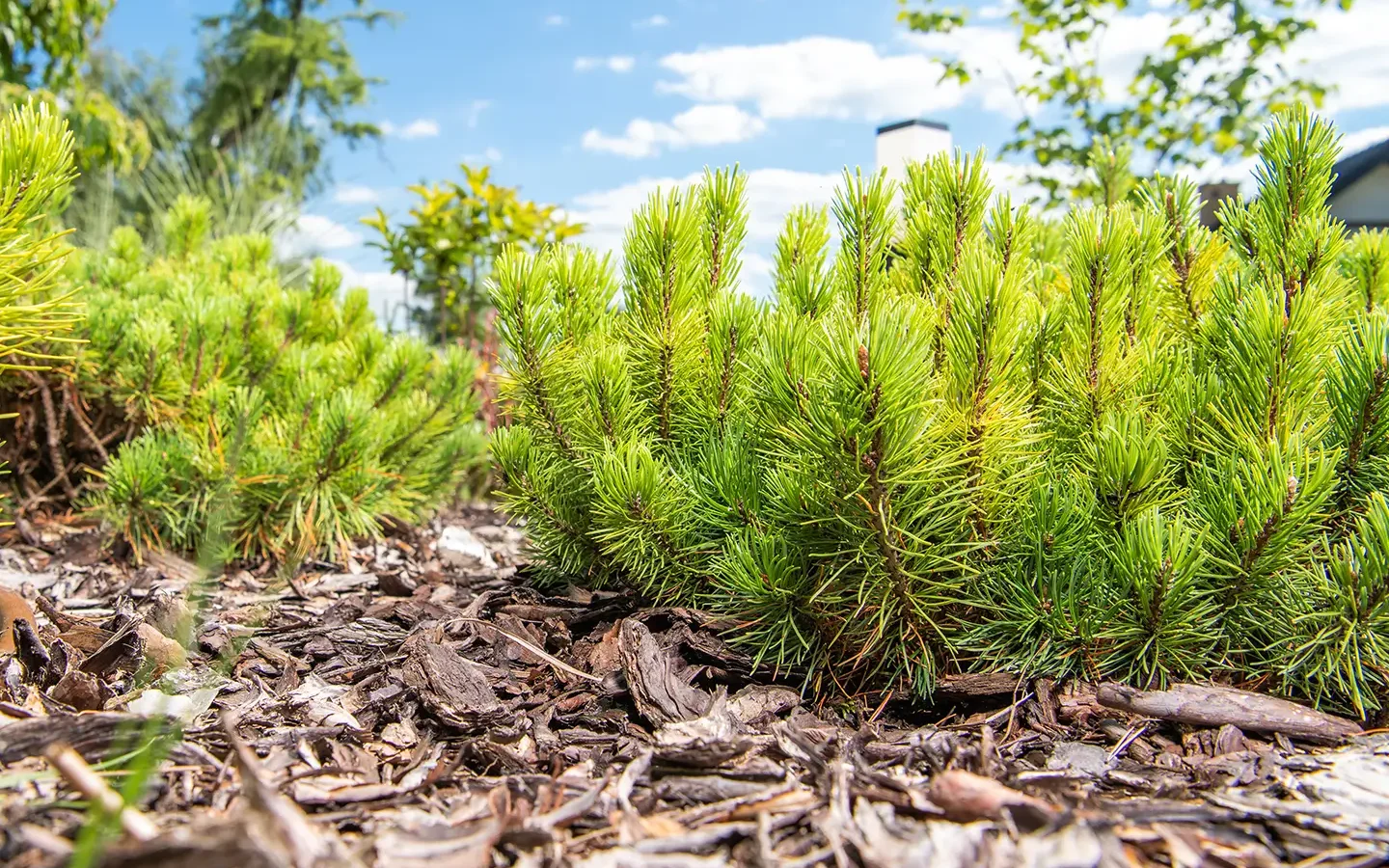
PINUS MUGO, known as dwarf mountain pine, bog pine, creeping pine, mugo
pine, mountain pine, scrub mountain pine, or Swiss mountain pine.
It is a coniferous specie, which can reach a height of 1.5-4 m. It is a shrub species, that make up compact bushes, hard to get through. In alpine areas the plant adapts to strong winds and to thick layers of snow. It reaches maturity very quickly. From 6-10 years it can produce cones. They are small, ovoid-globular. The scales of the cones shelter winged seeds. At maturity, very late autumn or winter, the cone scales unfold, facilitating the flight of seeds carried by the wind. About 100,000 peeled seeds equal 1 kg. Growth is very slow, it is a very dense wood, which due to its small size, can only be used for fire. High quality turpentine can be extracted from its resin.
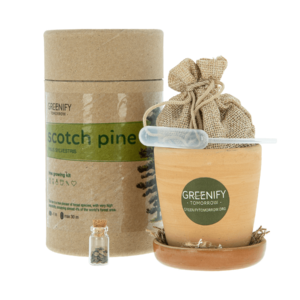
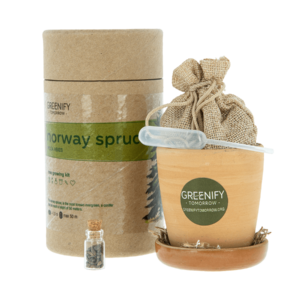
Cylindrical cardboard packaging, reusable in the household as a container for various objects, as a “piggy bank”, or as a support for writing instruments on the desk. Being made of cardboard, it is not resistant to moisture and can swell, therefore it can be damaged. The cylinder is recyclable, and by reuse you protect NATURE.
Clay pot. Burnt clay is a brittle material. Be careful not to drop it, as it can break very easily. Although the kit encourages you to work with children, please be careful so they do no not get harmed with any shards resulting in the unfortunate event that the pot breaks. Don’t worry, if the pot is broken, you can continue the project with any other container, provided it is about the same size and has a small excess drain hole at the base.
Sack with soil. The soil is a mixture of peat and compost. Both components are vegetal in nature. It does not contain additives or synthetic chemicals. It is not edible. The sack is reusable after a previous wash.
Pipette. We considered it necessary for a controlled dosage of the amount of water. It is the only plastic object. Please reuse it after completing this project for other purposes. If you still decide to throw it away, please do it selectively, with plastic waste, to be recycled.
Seed bottle. We chose to use the bottle as a container for the seeds because they are perishable. Like the clay pot, the bottle is brittle. It can break, and shards can cause cut wounds. You can reuse it or throw it away selectively.
- Mugo pine seeds (Pinus mugo). The seeds are from cones collected from the Curvature Carpathians – Brașov Depression (Piatra Mare Massif) – in 2021, from the altitude of 1700 m. The germination percentage of the seed lot is 75%, which means that statistically, three out of four seeds have a probability to sprout and give life to a tree. The seeds of this species are not edible, but their ingestion will not require any medical intervention. They are not treated with chemicals, touching them with your hand does not cause allergies. If they are not used immediately upon purchase, store the seeds in the refrigerator between 3-10 C. Thus, it retains its germination power for 1-2 years.
1. What happens if the seeds reach too deep into the soil?
If the seeds reach too deep, they risk not being able to penetrate the soil layer and will perish before sprouting.
2. What happens if the seeds become too shallow?
If the seeds become too shallow, they will germinate very quickly, the plant not having enough time to form a suitable root, so the seedlings will overturn.
3. Too little water?
If it receives too little water, it will wither. At this early age, a wilted plant can rarely be restored to its original state.
If it is considered that the water added according to the guide is too little, it is up to you to adjust the quantity. In these growth stages, the plants are very sensitive to deficit of water.
4. Too much water?
If it has too much water, it risks rotting.
If it is considered that the water added according to the guide is too little, it is up to you to adjust the quantity. In these growth stages, the plants are extremely sensitive to excess water.
5. What to do with the refrigerated seeds?
You can use any other container and flower soil to grow a new generation of seedlings. They will usually sprout more seeds, which will later become seedlings. It is not desirable to separate them at this early age. They will be able to separate at transplanting, but carefully, without shaking too much soil.
6. Should I use fertiliser?
You should not use fertiliser, artificial or natural fertilizers for as long as the seedlings are in the pot and in the soil in the kit.
What will you find in the Dwarf mountain pine Kit
What will you find in the Dwarf Mountain Pine Dwarf Mountain Pine kit
![dwarf mountain pine [transparent]](https://greenifytomorrow.org/wp-content/uploads/elementor/thumbs/dwarf-mountain-pine-transparent-q8x9bphuewgnywkmvlh22wtlhrfks6m42buggmulbk.png)

Plant your tree today
You and your tree, a legacy for your upline.
So, .
Day zero
STEP 1
Put the pot on the small plate. Open the bag of soil and fill the pot up to the black mark inside. Level the soil.
Open the cap of the seed bottle and sprinkle half of the seeds on the soil. Close the remaining seed bottle and store it in the fridge. The stored seeds will be a backup in case of failure. The seeds can be stored for several years in the sealed bottle. The germination rate increases by about 10% per year.
Put the remaining soil over the seeds. Level the soil and gently tap it with your finger. Make sure that all the seeds are evenly covered. Fill a glass with water and dose the water with a pipette until the excess water comes out through the pot’s spout into the dish. This is the only time we recommend using more than one dose of water. From here on, use two pipettes of water daily. If you try to water the pot with tap water or another container, you risk washing the soil of the seeds. If you forget to water, you can make up for it by putting extra drops of water.
Put the pot in a bright place, but away from heat sources.
Day 10 to 60
STEP 2
Seeds will sprout 10-20 days after potting. Small sprouting gaps may occur, so don’t panic and don’t dig up the soil looking for seeds. By moving sprouted seeds, they will stop growing. If they have not sprouted after 30 days, carry out the operation with the spare seeds stored in the fridge.
At first, the seeds are pushed up and a very small root is formed. A few days after the seeds have broken through the soil crust, they will start to grow, with the sheath up. This sheath will fall off by itself. Don’t touch the sheath, don’t try to remove it by hand because you will damage the first little leaves, called needles. There are 6-8 of them and after the sheath falls off, they will open like a rosette. The plant will apparently stagnate for a long time at this stage.
Remember to water the pot every day with 2-3 drops of water. This is the most critical period in the life of this tree.
Some specimens will not survive this stage for genetic reasons, from
due to excess physical factors or conversely, due to lack of them (e.g. too much water, or
too little water). Some microscopic fungi, whose spores are pre-existing in
the soil used can also be damaging.
Day 60 to 365
STEP 3
From the second month the plant will grow in height.
After the second month you can stop watering with a pipette because the soil will become so textured that it is possible from other sources.
From the third month onwards, you no longer need to water daily, but check the soil and keep it moist at all times.
In the first year the seedlings will reach 5-12 cm tall.In the second year it is desirable to move the plant to a larger pot of 2 litres.
You can use commercial flower potting soil, or soil from your own garden.
The roots need more space. It does not tolerate clay, sandy and excessively wet soils. When transplanting, do not shake the soil off the roots.
Day 365 +
STEP 4
From the second year onwards it can be kept outdoors in a place out of the sun, but in winter it must be protected from frost.
Continue to water the pot weekly.
In summer the seedlings need water and shade.
In the third year, in spring, you can plant it in its permanent spot. Choose a spot where you won’t have to move it from.
It can grow up to 1.5-4 m. Choose the spot so that it does not endanger the safety of the surrounding buildings and make sure there are no pipes under the saplings.
It branches out and over time it will develop a bushy appearance.
The best time for transplanting is spring in April-May.